



DNA Methyltransferase
DNMTs; DNA MTases
DNA methyltransferases (DNMTs) are a family of “writer” enzymes responsible for DNA methylation that is the addition of a methyl group to the carbon atom number five (C5) of cytosine. Mammalians encode five DNMTs: DNMT1, DNMT2, DNMT3A-DNMT3B (de novo methyltransferases), and DNMTL. DNMT1, DNMT3A, and DNMT3B are the three active enzymes that maintain DNA methylation. DNMT3L has no catalytic activity and functions as a regulator of DNMT3A and DNMT3B, whereas DNMT2 acts as a tRNA transferase rather than a DNA methyltransferase.
DNA methylation is a vital modification process in the control of genetic information, which contributes to the epigenetics by regulating gene expression without changing the DNA sequence. In prokaryotes, DNA methylation is essential for transcription, the direction of post-replicative mismatch repair, the regulation of DNA replication, cell-cycle control, bacterial virulence, and differentiating self and non-self DNA. In mammalians, DNA methylation is crucial in many key physiological processes, including the inactivation of the X-chromosome, imprinting, and the silencing of germline-specific genes and repetitive elements.
DNA Methyltransferase Isoform Specific Products
All Product Categories
-
DNA Methyltransferase Related Products (147)
Related Products (147)

-
Antibodies (11)
-
DNA Methyltransferase Isoform Comparison
-
MC3817 free base
 0 ImagesCat. No.: HY-179409AMC3817 free base is a selective DNMT1 inhibitor. MC3817 free base inhibits DNMT1 and DNMT3A/3L with IC50s of 0.044 μM and > 10μM, respectively. MC3817 free base inhibits P53-dependent cancer cell proliferation, induces apoptosis and DNA damage. MC3817 free base elevates cleaved Caspase 3, P53, and γH2AX. MC3817 free base can be used in non-small cell lung cancer, colon cancer, cervical cancer, triple-negative breast cancer and histiocytic lymphoma research.
-
TS-002455
 0 ImagesCat. No.: HY-168346CAS No.: 2702331-04-0
-
DNMT1 aptamer sodium
 0 ImagesCat. No.: HY-177807DNMT1 aptamer sodium is a DNA aptamer for binding and inhibition of DNA methyltransferase 1 (DNMT1).
-
DNMT-IN-3
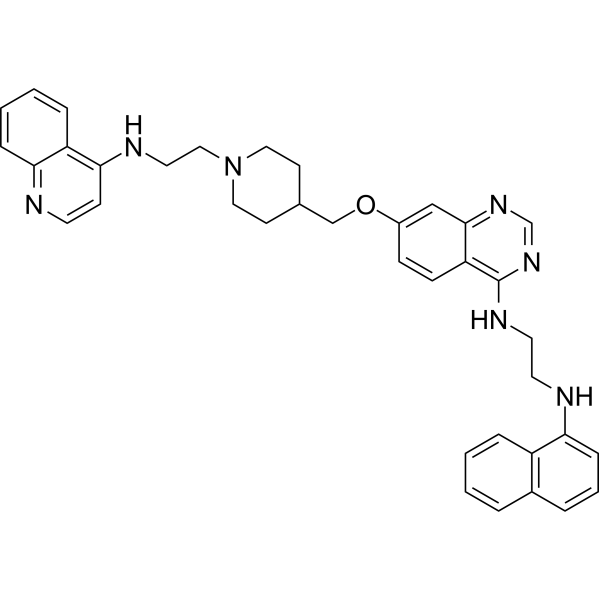 0 ImagesCat. No.: HY-149289CAS No.: 1683516-27-9DNMT-IN-3 is an DNA Methyltransferase (DNMT) inhibitor, and plays an antimalarial role with IC50 of 60 nM against Plasmodium falciparum (Plasmodium). DNMT-IN-3 can be used for malaria related research.
-
SARS-CoV-2 nsp14-IN-1
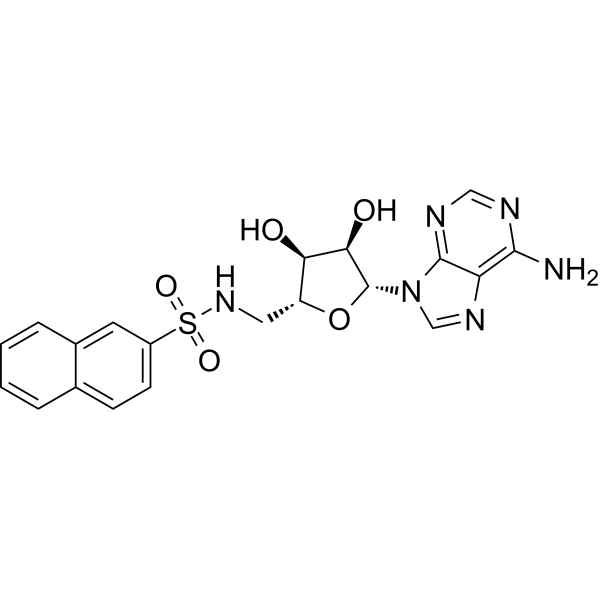 0 ImagesCat. No.: HY-150680CAS No.: 2816165-02-1SARS-CoV-2 nsp14-IN-1 (Compound 3) is a prototypic bisubstrate inhibitor of SARS-CoV-2 Nsp14 MTase with an IC50 value of 0.061 μM. SARS-CoV-2 nsp14-IN-1 (Compound 3) has an excellent selectivity profile over a panel of human methyltransferases, can against apanel of 10 human MTases including histone lysine, proteinarginine, and DNA and RNA MTases.
-
DNMT-IN-6
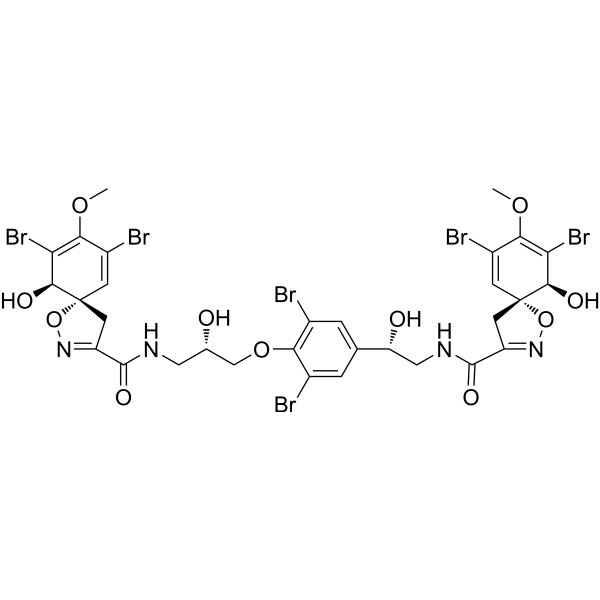
 0 ImagesCat. No.: HY-182009CAS No.: 3038316-36-5DNMT-IN-6 is a DNA methyltransferase inhibitor with activity against DNMT1, DNMT3A, and DNMT3B. DNMT-IN-6 drives demethylation, and restores TMS1 tumor suppressor gene expression. DNMT-IN-6 induces apoptosis, causes G2/M phase arrest, disrupts mitochondrial integrity, and activates the intrinsic caspase cascade (3/7/9). DNMT-IN-6 inhibits tumor growth, and improves survival in xenograft models. DNMT-IN-6 can be used for the research of cancer, such as diffuse large B-cell lymphoma.
-
DNMT1-IN-3
 0 ImagesCat. No.: HY-161694CAS No.: 3025012-68-1DNMT1-IN-3 (compound 7t-S) is an effective DNA methyltransferase 1 (DNMT1) inhibitor with an IC50 value of 0.777 μM and a KD value of 0.183 μM. DNMT1-IN-3 can bind to the methyl donor S-adenosyl-l-methionine (SAM) site in DNMT1. DNMT1-IN-3 can inhibit cell proliferation in K562 cells by inducing cells apoptosis and arresting cell cycle at G0 / G1 phase, which has the potential to be used for the research of hematologic tumor.
-
Levetiracetam-d6
 0 ImagesCat. No.: HY-B0106SCAS No.: 1133229-29-4Synonyms: UCB L059-d6Levetiracetam-d6 is the deuterium labeled Levetiracetam. Levetiracetam, an antiepileptic agent, binds the synaptic vesicle protein SV2A. Levetiracetam enhances Temozolomide effect on glioblastoma stem cell proliferation and apoptosis. Levetiracetam modulates HDAC levels ultimately silencing MGMT, thus increasing Temozolomide effectiveness. A chemosensitizer agent.
-
DNMT1-IN-5
 0 ImagesCat. No.: HY-172217CAS No.: 2982511-19-1DNMT1-IN-5 (Compound 55) is the inhibitor for DNMT that inhibits DNMT1 and DNMT3A with IC50 of 2.42 μM and 14.4 μM. DNMT1-IN-5 exhibits antiproliferative activity in a variety of cancer cell lines (IC50s for TMD-8, DOHH2, MOLM-13, THP-1, RPIM-8226 and HCT116 are 0.19-2.37 μM), arrests the cell cycle at G2/M phase, and induces apoptosis in TMD-8 and DOHH2 cells. DNMT1-IN-5 exhibits antitumor efficacy in TMD-8 xenograft mouse models.
-
J208
 0 ImagesCat. No.: HY-163535CAS No.: 2116468-11-0J208 is a dual inhibitor for histone deacetylase (HDAC) and DNA methyltransferase (DNMT). J208 inhibits proliferation of cancer cells, as well as the migration/invasion of triple-negative breast cancer (TNBC) cells. J208 induces apoptosis, arrests the cell cycle at G0/G1 phase. J2008 activates the innate immune signalling pathway in TNBC, by inducing the expression of endogenous retroviruses (ERVs).
-
Anticancer agent 333
 0 ImagesCat. No.: HY-186228CAS No.: 3075414-82-0Anticancer agent 333 is a tetrazinone anticancer agent with broad-spectrum anticancer activity, targeting MGMT/AGT-deficient cancer cells (IC50≤20 μM). Anticancer agent 333 exhibits favorable safety profiles in rat and canine animal models. Anticancer agent 333 can be used for the research of MGMT-deficient cancers and related tumors.
-
(S)-Kaempferide
 0 ImagesCat. No.: HY-15449A(S)-Kaempferide (ZINC167686681) is a DNA methyltransferase (DNMT) inhibitor. (S)-Kaempferide can be used in tumor research.
-
EcoRI Methyltransferase
 0 ImagesCat. No.: HY-E70209CAS No.: 81458-00-6EcoRI Methyltransferase is a bacterial sequence-specific S-adenosyl-L-methionine-dependent DNA methyltransferase. EcoRI Methyltransferase relies on a complex conformational mechanism to achieve its remarkable specificity, including DNA bending, base flipping and intercalation into the DNA.
-
Procainamide (Standard)
 0 ImagesSynonyms: Procaine amide (Standard); SP 100 (Standard)Procainamide (Standard) is the analytical standard of Procainamide. This product is intended for research and analytical applications. Procainamide (Procaine amide) is a specific and potent inhibitor of DNA methyltransferase 1 (DNMT1), which reactivates the expression of tumor suppressor factors by demethylating tumor suppressor genes. Procainamide induces vacuolization in various cell types and reduces cell proliferation and migration. Procainamide relaxes airway smooth muscle by activating potassium channels. Procainamide can be used in cancer and arrhythmia research.
-
GSK-3484862 (GMP)
 0 ImagesCat. No.: HY-135146GCAS No.: 2170136-65-7Synonyms: (R)-GSK3482364 (GMP)GSK-3484862 GMP is GSK-3484862 (HY-135146) produced by using GMP guidelines. GMP small molecules works appropriately as an auxiliary reagent for cell therapy manufacture. GSK-3484862 is a highly potent non-covalent inhibitor and demethylating agent of DNMT1. GSK-3484862 induces genome-wide DNA demethylation, including the regulatory elements of DNMT3B and the promoter region of TERT, and significantly inhibits cell viability, growth, proliferation and self-renewal. GSK-3484862 blocks the transformation of young AT2 cells, induces apoptosis, and generates transcriptomic features similar to those of senescent cells. GSK-3484862 is widely used in studies related to lung cancer, oral squamous cell carcinoma and lung adenocarcinoma.
-
RU-0415529
 0 ImagesCat. No.: HY-170523CAS No.: 1358734-35-6RU-0415529 is an orally active inhibitor for SARS-CoV-2 nonstructural protein 14 (NSP14) with an IC50 of 356 nM. RU-0415529 binds to the SAH-stabilized cap binding pocket, inhibits viral RNA methylation and the viral replication. RU-0415529 exhibits anti-infectious activity in mouse models.
-
DNMT/HDAC-IN-2
 0 ImagesCat. No.: HY-175988CAS No.: 2548725-57-9DNMT/HDAC-IN-2 (Compound Y7) is a DNMT and HDAC inhibitor with IC50 values for DNMT1, HDAC1, and HDAC6 of 365, 0.2, and 8.91 nM respectively. DNMT/HDAC-IN-2 inhibits the proliferation of breast cancer cells. DNMT/HDAC-IN-2 significantly reduces tumor growth in xenografts and transgenic breast cancer mouse models. DNMT/HDAC-IN-2 can be used for the study of breast cancer.
-
USP7-IN-18
 0 ImagesCat. No.: HY-174301CAS No.: 3052223-40-9USP7-IN-18 is a naphthalene derivative. USP7-IN-18 is a selective USP7 inhibitor (IC50 : 130.9 nM), with no or very weak inhibition of the other 8 DUBs including USP47. USP7-IN-18 specifically binds to the catalytic domain of USP7, blocking its deubiquitinase activity. USP7-IN-18 causes degradation of the oncogenic proteins MDM2 and DNMT1, and also degrades the novel target PCLAF. USP7-IN-18 activates the p53-p21 pathway. USP7-IN-18 exerts anti-tumor effects in colon cancer animal models and reshapes the tumor immune microenvironment. USP7-IN-18 achieves both direct cytotoxic and immune-synergistic anti-tumor actions.
-
DNMT2-IN-1
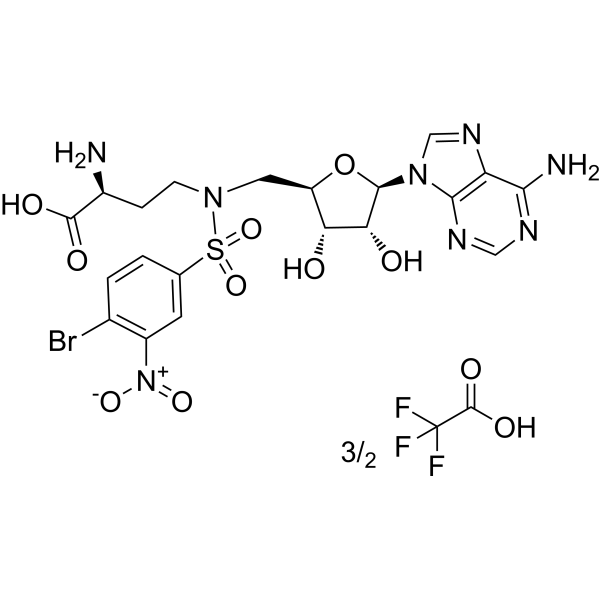 0 ImagesCat. No.: HY-154867DNMT2-IN-1 (compound 80) is a potent and selective DNMT2 (DNA methyltransferase 2) inhibitor with an IC50 value of 1.2 μM, and has the potential for mental and metabolic disorders or cancer research.




